Originally published on Growth by Design

    This article was first published on the Growth by Design newsletter by Diraj Goel, CEO of GetFresh Ventures

    Captivated (Part 1): The Audience That Changes Everything
    Why every startup lives or dies by its ability to find the customers who can't live without them.

    By Diraj GoelOctober 2, 2025
    8 min read
    Captivated (Part 1): The Audience That Changes Everything

    Share:

    This is the first article in my new series, Captivated.

    Each week, I’ll explore the single most important force in startup growth: the audience who can’t live without you.

    Not the ones who say your product is “cool.” Not the ones who’ll try it once and disappear. The audience that pays, stays, and advocates because your solution answers a problem so critical it can’t be ignored.

    These are Captivated Audiences. They don’t just like your product. They endure friction, inconvenience, even social risk to keep using it. When you find them, markets bend. When you miss them, growth stalls no matter how much capital you raise or how talented your team is.

    This series builds from real stories and frameworks I’ve used across decades of scaling companies.

    Each article can stand alone with actionable takeaways you can apply immediately, but together they form a playbook: how to identify mission-critical problems, design no-brainer solutions, avoid false signals, build engines that scale to $10M, and flip investor conversations so you’re not asking for money but choosing who gets on your cap table.

    Over this series, we’ll explore examples from Uber, Canva, NetSuite, Figma, and more. We’ll look at how captivated audiences are uncovered, validated, scaled, and defended — and why they’re the difference between startups that thrive and startups that die.

    But before frameworks, let’s talk about what a captivated audience looks like in its rawest, most undeniable form.


    Paris, Nice, and the Uber Wars

    June 2015.

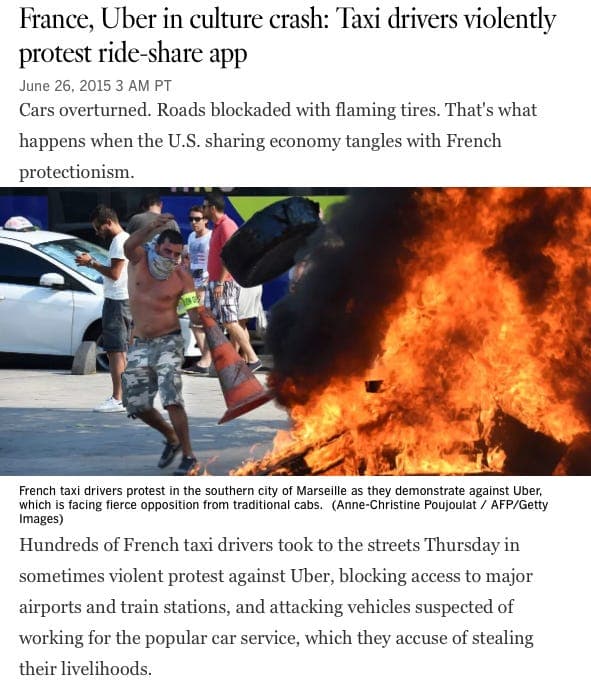
    I was in Paris and then in Nice, right as Uber was in open warfare with the French taxi industry.

    What I walked into wasn’t just tension. It was chaos.

    Taxi drivers staged strikes across the country. They blocked highways and airports. They burned cars. They were furious at Uber’s expansion into France. They had controlled mobility for decades, backed by government regulation and scarce taxi medallions. Suddenly, here was a company using ordinary cars and an app to erode that monopoly.

    Executives at Uber France were arrested and paraded as criminals. The media painted Uber as an illegal taxi company trying to bulldoze its way into Europe.

    One night in Nice, I ordered an Uber. When the driver arrived, he asked me to sit in the front seat and pretend to be his friend. He explained that taxi drivers were hunting down Uber drivers, luring them into alleys, flipping cars, and beating them. He described colleagues who had been ambushed and hospitalized.

    We rode together through the city streets pretending to be two friends out for the night, but the stakes were life and death for him. And yet, despite the danger, I kept using Uber. The alternative — waiting twenty minutes for a taxi that might not come, hauling luggage across barricaded streets, missing flights — was worse.

    Captivated (Part 1): The Audience That Changes Everything

    A global celebrity, Courtney Love Cobain, caught in an Uber during the riots, tweeted in real time to her millions of followers.

    Through all of this, Uber rides kept happening. People kept pressing the button. Once you’ve experienced that kind of freedom — the ability to get a ride instantly, without waiting on a taxi rank, without worrying about cash, without calling a dispatcher — you don’t go back.

    Even when violence, risk, and government resistance were at their peak, the demand didn’t vanish. Customers tolerated inconvenience, even danger, to get what Uber offered: mobility on demand

    And yet, Uber demand didn’t collapse. It grew.

    That is what it means to have a captivated audience.


    Why People Endured Violence for an App

    At first glance, it sounds absurd. Why would anyone risk walking past burning barricades or getting caught in a street fight — for an app? Why not stay home, call a friend, or wait out the chaos?

    The answer is that Uber wasn’t solving for “better taxis.” It was solving for freedom of movement, one of the most primal human needs.

    Mobility isn’t a luxury. It’s how we experience life, earn income, maintain relationships, and pursue opportunities. If you’ve ever missed a flight, been late to an important meeting, or stood helpless in the rain waving at taxis that never stop, you know how much agency you lose when you can’t move on your own terms.

    Uber collapsed that friction into a button. You pressed, and a car showed up. The product didn’t promise convenience. It promised control.


    The Three Dimensions of Mission-Critical Problems

    This is why people endured violence to use Uber: the problem hit at the intersection of money, time, and desire.

    • Money: Missing a flight costs hundreds, sometimes thousands, and sets off cascading losses. A late meeting could mean a lost deal. Uber turned uncertain transportation into predictable outcomes, protecting customers from expensive misses.

    • Time: Time is the one currency you never get back. Waiting 20–30 minutes for a taxi was wasted life. Uber compressed waiting time to minutes, sometimes seconds. That psychological shift — from uncertainty to control — is priceless.

    • Desire: Humans crave agency. Uber wasn’t just about moving people. It was about moving when you wanted, where you wanted, how you wanted, without depending on someone else. Comfort, privacy, silence — or conversation if you chose. Desire fulfilled as easily as tapping a button.

    When a solution touches all three — money, time, desire — it becomes visceral.


    The Psychology of Control and Dopamine

    Behavioral psychologists will tell you: humans endure hardship if the payoff restores control. In fact, the dopamine hit is greater when relief follows pain.

    Uber wasn’t just a ride. It was a dopamine machine:

    • You tap. The app shows the driver’s face, license plate, arrival time. Certainty replaces uncertainty.

    • The car arrives. You didn’t wait in the rain, you didn’t plead at a taxi stand. Control replaces helplessness.

    • You arrive where you want, when you want. The promise is kept. Desire is fulfilled.

    That loop is addictive because it resolves the very anxieties humans hate: helplessness, unpredictability, and wasted time.

    When taxi drivers lit cars on fire, customers didn’t see “danger.” They saw the last gasp of an obsolete system trying to claw back control. And they weren’t about to surrender the control they’d just gained.


    Examples of Enduring for Mission-Critical Solutions

    Uber wasn’t unique. Across history, customers have endured enormous resistance to get access to solutions that answered urgent needs:

    • AOL and early internet dial-up: People endured screeching modems, constant busy signals, and long wait times for tech support because the value of being connected was so powerful.

    • Early iPhones: Customers camped on sidewalks overnight, enduring weather and crowds, because the device collapsed time, money, and desire into one product.

    • Figma: Designers fought through company IT restrictions, using personal emails or shadow accounts, because real-time collaboration was too valuable to give up.

    These audiences weren’t just “interested.” They were captivated.


    The Truth Test: Living, Breathing, Paying Customers

    Here’s where most founders stumble. They confuse interest with captivation.

    • A filled-out survey is not evidence.

    • A polite “let’s keep in touch” is not evidence.

    • A free signup is not evidence.

    Those are signals of curiosity, not commitment.

    The only signal that matters is a living, breathing, paying customer with a name you can talk to. Someone who has shifted part of their workflow, budget, or life around your product because the alternative is unacceptable.

    That’s the difference between noise and traction.


    Why Paying Matters

    Money is commitment crystallized. When someone pays, they’re not just expressing interest — they’re choosing to endure the trade-offs:

    • The friction of onboarding.

    • The loss of their cash.

    • The risk that you might fail them.

    That decision is heavy. It means the problem is urgent enough that they’re willing to absorb risk, spend resources, and adapt behavior.

    If they’re not paying, you don’t know if they’re serious.


    Why Living and Breathing Matters

    Some founders celebrate “10,000 signups” or “50,000 users.” But if you can’t call one of them by name and have them tell you how your product makes their life better, you don’t have traction.

    Real evidence looks like:

    • A customer who reorganized their team workflow around your app.

    • A family who budgets differently because of your service.

    • A manager who moved budget from another tool to fund yours.

    These are not abstract “users.” They’re human beings who changed behavior to accommodate you.


    Case Studies of the Truth Test in Action

    • Slack: Early teams using Slack didn’t “test” it. They lived in it. They stopped using email, organized entire workflows around it, and invited teammates in because it was unbearable to go back. That’s living, breathing, paying proof.

    • Canva: Marketers who once paid designers hundreds for simple graphics started building them in Canva themselves. Budgets shifted. Agencies lost contracts. Canva wasn’t curiosity — it was commitment.

    • Figma: Designers bypassed IT restrictions, used personal accounts, and risked policy violations because real-time collaboration was that urgent. They literally bent rules to keep using it. That’s captivation.

    Compare that to the “graveyard” of apps with huge free user bases that never converted to revenue — Evernote’s early bloat, Clubhouse’s hype spike, Quibi’s collapse. Those weren’t captivated customers. They were curious tourists.


    The Founder’s Takeaway: How to Test for Captivation

    If people are willing to endure inconvenience, pushback, or even danger to keep using your product, you’ve solved a mission-critical problem. That’s the difference between curiosity and captivation.

    But you can’t guess at this. You need a process to test it. Here’s the Socratic check every founder should run:

    About Diraj Goel

    Diraj is the CEO and Founder of GetFresh Ventures. He's an operator who has scaled companies to $100M+ revenue and helped 200+ fellow companies raise $500M+ collectively through the Growth by Design methodology.

    Continue Reading on Substack

    Get full access to this article and exclusive insights from Diraj Goel. Subscribe to receive in-depth analysis on venture capital, startups, and entrepreneurship.

    Expert insights & analysis
    Weekly updates
    Exclusive content

    Continue Reading

    Explore more insights on startup growth, funding, and scaling strategies.